
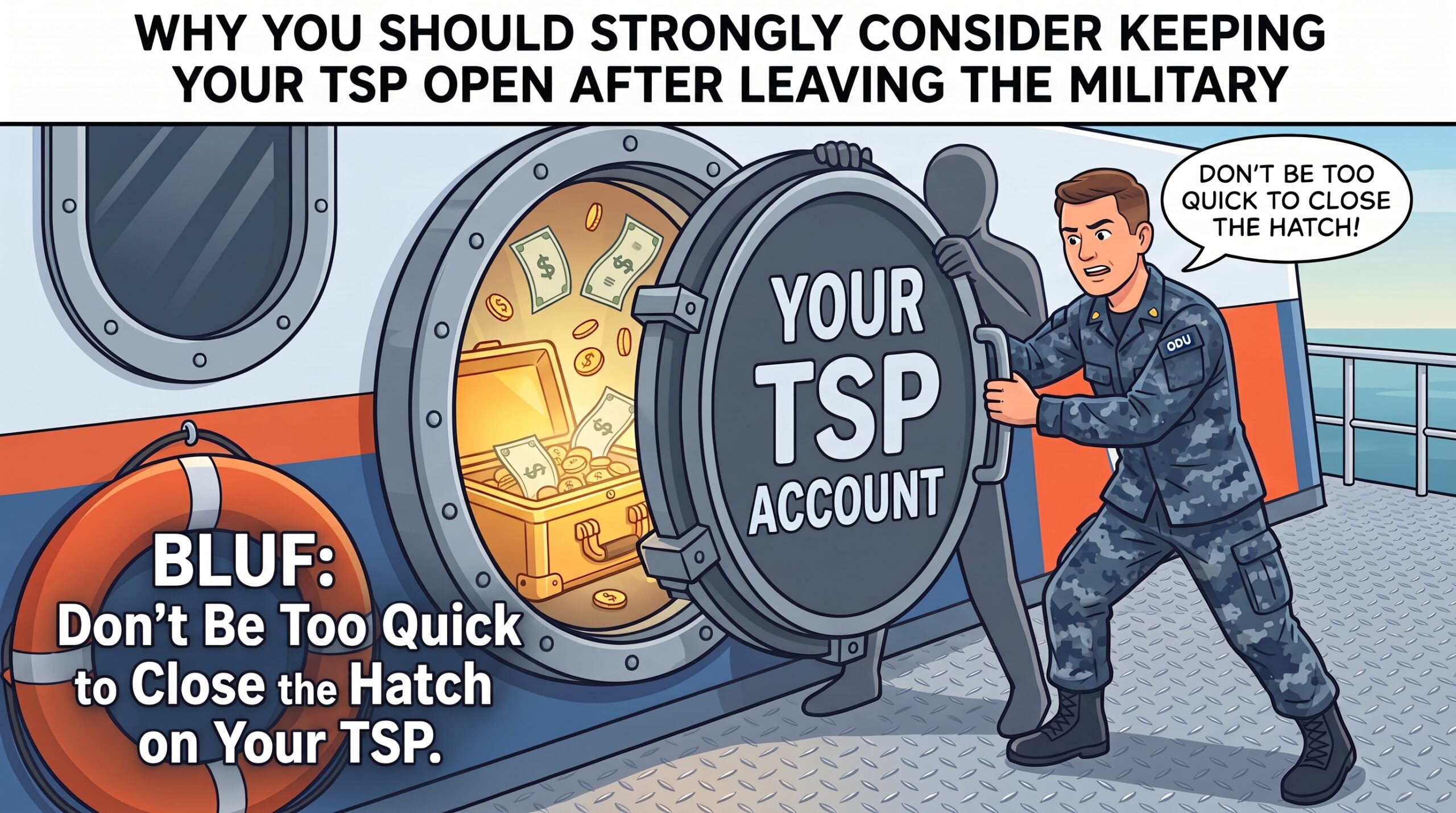
BLUF:
Don’t Be Too Quick to Close the Hatch on Your TSP
When you retire or separate from the military, one of the financial decisions you’ll face is what to do with your Thrift Savings Plan (TSP).
Leave it where it is?
Roll everything into an IRA?
Move it into your new employer’s 401(k)?
The answer will depend on your situation. But there is one option I think every separating or retiring service member should strongly consider:
Keep your TSP open—even if you decide not to keep all of your retirement money there.
Why?
Because once you close your TSP completely, you may be giving up access to a remarkably low-cost retirement plan, the unique G Fund, and a place where you can potentially consolidate eligible retirement accounts later.
The TSP says that if you leave the uniformed services with an account balance of at least $200, you can leave your money in the plan. You can no longer make regular payroll contributions after separating, but you can continue managing the investments already there.
Even more importantly, an existing TSP account can accept rollovers from certain eligible retirement plans in the future.
That flexibility has value.
So before you give the order to transfer everything out, make sure you understand exactly what you may be giving up.
1. The TSP Is Still an Exceptionally Low-Cost Retirement Plan
One of the TSP’s biggest advantages has always been its cost.
The TSP’s core funds operate with very low expenses compared with many retirement-plan investment options.
Put that in plain English: very little of your investment return is being siphoned away by fund expenses.
Now, does that automatically mean the TSP is cheaper than every IRA or 401(k)?
No.
There are plenty of very inexpensive index funds and ETFs available outside the TSP today. Cost alone is not a reason to keep every dollar in the plan.
But it is a reason not to casually abandon it.
During transition, you’re going to hear plenty of suggestions about rolling your TSP somewhere else. Sometimes moving money makes sense. You may want more investment choices, different withdrawal flexibility, Roth conversion opportunities, or an investment strategy that is easier to coordinate with your other accounts.
Those can all be legitimate reasons.
But “I retired, so I guess I’m supposed to roll over my TSP” is not a financial plan.
Your military career probably taught you not to surrender a useful capability without first understanding what it does for the mission.
Treat your TSP the same way.
2. Keeping the TSP Open Preserves
Access to the G Fund
For many retirees, this may be the biggest reason to keep the account.
The G Fund—Government Securities Investment Fund—is unique to the TSP.
It invests in special U.S. Treasury securities issued specifically to the TSP. Its objective is to provide interest income without the risk of losing principal from market fluctuations.
That combination can make the G Fund particularly useful when you’re building a retirement-income strategy.
Think about the challenge.
Once you’re retired, not every dollar has the same mission.
Some money may be earmarked for growth 15 or 20 years from now.
Other money may need to cover expenses next year.
Those dollars probably shouldn’t all be taking the same amount of risk.
The G Fund can potentially serve as one of the more conservative compartments of your retirement portfolio—a place for money where preserving principal matters while still earning an interest rate based on longer-term government securities.
That doesn’t mean everyone should pile into the G Fund.
It means having access to it gives you another tool.
And financial readiness is often about maintaining useful options before you need them.
Once you’ve emptied and closed your TSP, that option may no longer be available to you.
3. Your TSP Can Become a Useful Consolidation Point
Here’s the part many transitioning service members overlook.
Keeping the TSP open doesn’t just preserve the money already inside it.
It can preserve a destination for future rollovers.
The TSP allows participants with an existing account to roll eligible money into the plan from retirement accounts such as certain 401(k)s, 403(b)s, and traditional IRAs.
Imagine you retire from the military at 45 or 50 and begin a second career.
Over the next 10 or 15 years, you might work for two or three different employers. Before long, your retirement picture could look something like this:
- TSP
- Employer #1 401(k)
- Employer #2 401(k)
- Traditional IRA
- Roth IRA
- Taxable investments
That isn’t necessarily bad.
But those old employer plans can create two issues worth paying attention to: cost and tax-planning flexibility.
Your Old 401(k) May Become More Expensive After You Leave
While you’re employed, your company may absorb some of the administrative or recordkeeping costs associated with its 401(k).
After you leave, that may change.
Depending on the plan, former employees may end up paying administrative expenses that the employer previously subsidized. You also need to consider the expenses of the investments available inside that particular 401(k).
Individually, those fees may not look dramatic.
But consider a retiring officer who builds a $500,000 or $1 million 401(k) during a second career. Even a relatively small difference in annual expenses can become meaningful when compounded over another 20 or 30 years.
If the old employer’s plan is more expensive than the TSP, rolling eligible assets from that old 401(k) into your TSP could potentially reduce costs while also simplifying your financial life.
That’s where keeping the TSP open can provide real optionality.
You don’t know today what your future civilian employer’s retirement plan will cost.
Keeping your TSP available means that when you eventually leave that employer, you may have another low-cost harbor available for those assets.
It May Also Help Preserve Your Backdoor Roth IRA Strategy
For higher-income military retirees entering a successful second career, this may be even more important.
Your civilian income may eventually become too high to make a direct contribution to a Roth IRA.
That’s when you may consider what is commonly called a backdoor Roth IRA: making a nondeductible contribution to a traditional IRA and then converting that money to a Roth IRA.
But there is a potential complication—the IRS pro-rata rule.
When determining how much of an IRA conversion is taxable, the IRS generally looks across your traditional, SEP, and SIMPLE IRA balances rather than allowing you to isolate only the after-tax dollars you just contributed.
Here’s why that matters.
Suppose you leave your civilian employer with a $700,000 401(k).
You could roll it into a traditional IRA.
That sounds simple.
But now you’ve created a $693000 pre-tax IRA balance.
If you later attempt a $7,000 backdoor Roth IRA contribution, that large pre-tax IRA balance causes 99% of the conversion to become taxable under the pro-rata calculation. If you are in the 22% tax bracket that would be more than $1,500 in additional taxes for that year!
Instead, if the plan and assets are eligible, you may be able to roll that old 401(k) into your TSP.
And here’s the important planning distinction:
Money held inside the TSP or a 401(k) is not included in the traditional IRA balances used for the IRA pro-rata calculation on Form 8606.
So keeping your TSP open may give you a future place to consolidate pre-tax retirement money without filling up your traditional IRA with hundreds of thousands of dollars that could interfere with a backdoor Roth strategy.
For a high-income military retiree in a second career, that can be a very valuable planning tool.
Think of the TSP as a Harbor You May Want Later
This is why I hesitate when someone tells a retiring service member:
“Just roll your TSP into an IRA. You’ll have more choices.”
Maybe.
But what capability are you giving up?
Keeping your TSP open preserves another destination for eligible retirement assets later in life. That could help you:
- Consolidate old employer retirement plans.
- Potentially reduce investment or administrative costs.
- Simplify the number of retirement accounts you’re managing.
- Preserve access to the G Fund.
- Keep large pre-tax balances out of traditional IRAs.
- Preserve greater flexibility for future backdoor Roth IRA contributions.
You don’t have to know today whether you’ll use all of those capabilities.
That’s the point.
Keeping the TSP open preserves the option.
And in financial planning, as in operational planning, there is value in maintaining a capability before you know you’ll need it.
4. You Don’t Have to Make an All-or-Nothing Decision
This may be the most important point in the entire article.
When service members ask me what they should do with their TSP after retirement, the conversation sometimes begins as though there are only two choices:
Choice A: Leave everything in the TSP.
Choice B: Roll everything out.
There is a third course.
Keep the TSP open while moving only the amount that serves a specific purpose elsewhere.
After separation, the TSP provides several distribution options, including partial distributions, installment payments, and total distributions.
That flexibility means your retirement plan does not have to be binary.
For example, you might decide an IRA offers features that better fit part of your financial plan while intentionally preserving part of your TSP for access to the G Fund or as a future consolidation destination.
Or you might decide the TSP already meets your investment needs and leave everything exactly where it is.
Either decision can be reasonable.
What matters is that the decision has a purpose.
At Always Ready Financial Planning, I come back to this idea constantly: your money should support what matters most to you. Your retirement accounts are tools for accomplishing that mission—not trophies to collect and not accounts to move around simply because someone tells you that you should.
Your TSP decision should fit into the bigger picture: your military pension, VA benefits, future civilian income, Social Security, spouse’s retirement accounts, education goals, tax strategy, and the life you actually want to build after service.
When Might Moving Money Out of the
TSP Make Sense?
I don’t want this article to become “The TSP is perfect and nobody should ever leave.”
It isn’t.
There are legitimate reasons you may want some—or potentially all—of your money somewhere else.
An IRA, for example, can provide a much broader investment universe. Depending on your planning strategy, an IRA may also provide more flexibility for account management, charitable planning, Roth conversions, or coordinating investments across a household.
Your new employer’s retirement plan might also have attractive features.
And sometimes simplicity works in the opposite direction: rather than keeping another account open, consolidating everything with a custodian you already use may make your financial life easier.
Those are planning decisions.
What I would be cautious about is rolling over your entire TSP simply because an advisor, broker, or salesperson tells you:
“You retired. This is what everybody does.”
Before moving everything, ask a better question:
What will I gain by moving this money—and what capability will I permanently give up?
That’s the conversation worth having.
A Word About Roth TSP
and Required Minimum Distributions
Another old argument for moving Roth TSP money into a Roth IRA has changed.
Beginning in 2024, Roth balances inside the TSP are no longer subject to required minimum distributions while the participant is alive.
That doesn’t make the Roth TSP and Roth IRA identical. They still have different rules and planning considerations.
But it does mean one historical reason for automatically moving Roth TSP money out of the plan has largely disappeared.
This is a good reminder of why financial decisions shouldn’t operate on old sea stories.
Rules change. Your plan should be based on today’s rules and your current mission.
The TSP Decision I Want You to
Make Before You Retire
Your transition checklist doesn’t need to say:
“Roll over the TSP.”
And it doesn’t need to say:
“Leave the TSP alone forever.”
It should say:
“Determine what role the TSP will play in my retirement plan before moving the money.”
Ask yourself:
- Do I value continued access to the G Fund?
- How do the TSP’s costs compare with my alternatives?
- Will I have other employer retirement accounts later that I may want to consolidate?
- Could keeping pre-tax assets inside the TSP help preserve my ability to use a backdoor Roth IRA strategy?
- Do I need investment choices unavailable inside the TSP?
- Would an IRA give me planning flexibility that I actually intend to use?
- How will this account fit alongside my military pension, Social Security, VA benefits, spouse’s accounts, and future civilian retirement plans?
- Am I moving the money because it improves my plan—or simply because somebody wants to manage it?
Those questions get you much closer to the right answer.
Guiding Takeaway:
Don’t Give Up a Capability Until You Know You Don’t Need It
Your TSP may represent decades of disciplined saving.
Treat the decision about what happens to it with the same seriousness.
You may ultimately determine that keeping your entire balance in the TSP is the best course.
You may decide to move a significant portion somewhere else.
But for many retiring service members, keeping enough money in the TSP to preserve the account deserves serious consideration.
The TSP gives you a combination of low expenses, straightforward investment choices, the unique G Fund, and the ability to accept certain eligible rollovers later.
It may also give you a valuable place to consolidate future employer retirement plans, potentially reduce costs, and preserve tax-planning flexibility during a high-income second career.
That’s a useful financial capability.
And once you’ve closed the door, reopening it may not be an option.
Before you transfer your entire balance, take one small readiness step:
Write down exactly why you’re moving the money, what you’ll gain, and what you’ll give up.
If you can’t clearly answer all three, you probably aren’t ready to execute the transfer yet.
Your retirement deserves more than a default decision.
Know your position. Lay down your track lines. Then get underway.
This article is intended for general financial education and should not be considered individualized investment, tax, or legal advice. Your TSP and Roth IRA strategies should be evaluated in the context of your complete financial and tax situation.